Navigating the Low-Code Landscape: A Comparative Analysis of Uniface, OutSystems, Mendix, and PUNKU.AI
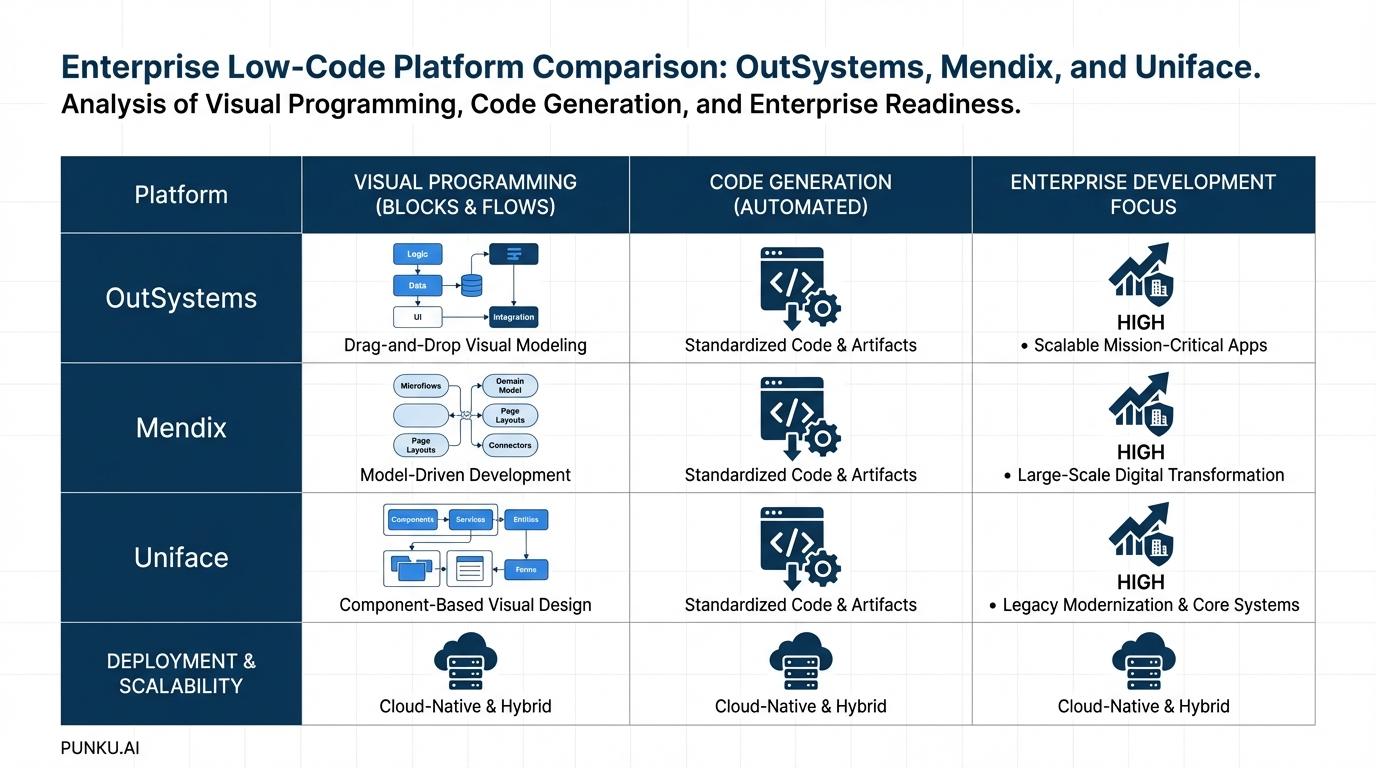
Key Takeaways
Executive Summary
The enterprise software development landscape is undergoing a seismic shift, driven by the urgent need for digital transformation and a chronic shortage of skilled developers. Low-code and no-code platforms have emerged as the primary solution to this bottleneck. According to Gartner, low-code application platforms (LCAPs) are projected to be used for mission-critical application development in 80% of businesses globally by 2029, up from just 15% in 2024 [1, 2].
This report provides a comparative analysis of four distinct platforms: OutSystems and Mendix, the recognized market leaders; Uniface, a veteran platform focused on mission-critical stability and legacy modernization; and PUNKU.AI, an emerging no-code player leveraging generative AI for workflow automation.
While OutSystems and Mendix dominate the analyst rankings (Gartner Magic Quadrant and Forrester Wave) for general-purpose enterprise development, Uniface retains a unique position through its extreme platform independence, including support for mainframes and OpenVMS. Conversely, PUNKU.AI represents the future of "AppGen" (Application Generation), moving beyond visual coding to natural language processing for automation. This analysis evaluates these platforms based on platform independence, mission-critical capabilities, and market positioning.
1. Market Landscape and Analyst Positioning
The low-code market has matured into a two-tier landscape: established enterprise platforms that replace traditional coding for core systems, and emerging AI-driven tools designed for rapid automation.
The Leaders: OutSystems and Mendix
Both Gartner and Forrester consistently rank OutSystems and Mendix as Leaders [3, 4, 5].
- Gartner Magic Quadrant (2024/2025): Identifies both as Leaders based on "Completeness of Vision" and "Ability to Execute" [2, 4].
- Forrester Wave: Recognizes OutSystems for its robust capabilities in rapid enterprise app development and Mendix for its strategic balance of citizen and professional development [3].
The Veteran: Uniface (Rocket Software)
Uniface, now part of Rocket Software, is characterized as a high-productivity platform with a legacy dating back to 1984 [6, 7]. While it does not currently occupy the "Leader" quadrant in recent generalist LCAP reports, which favor cloud-native, mass-market tools, it remains a critical player for organizations requiring deep legacy integration (e.g., IBM i, Mainframe) and absolute platform independence [8].
The Disruptor: PUNKU.AI
PUNKU.AI is a new entrant (founded 2024) representing the "Text-to-Agent" shift [9]. It operates in the no-code automation space rather than the heavy application development space. It targets the "busywork" of SMEs through natural language prompts rather than visual drag-and-drop interfaces [9].
2. Platform Deep Dives
2.1. OutSystems: High-Performance Low-Code
OutSystems positions itself as a "high-performance" low-code platform. It is designed to generate standard code (C#, JavaScript, SQL) that runs on a standard stack, aiming to eliminate the "black box" problem often associated with low-code tools [10].
- Core Philosophy: Developer-first. It focuses on professional developers, offering deep control over the full stack [11].
- Architecture: Offers two primary deployment models: OutSystems 11 (self-managed or private cloud) and OutSystems Developer Cloud (ODC), a cloud-native, AWS-based architecture using Kubernetes and microservices [11, 12].
2.2. Mendix: The Collaborative Ecosystem
A Siemens business, Mendix emphasizes the collaboration between IT and business stakeholders ("citizen developers").
- Core Philosophy: Democratization of development. It offers dual IDEs: Mendix Studio (for business users) and Mendix Studio Pro (for engineers) [13].
- Architecture: Cloud-native by design. It leverages a model-driven approach that is interpreted at runtime, which facilitates rapid iteration and flexibility [11].
2.3. Uniface: The Platform-Independent Workhorse
Uniface is a model-driven, low-code development and deployment platform designed for complex, data-intensive enterprise applications.
- Core Philosophy: "Write Once, Deploy Anywhere." Uniface separates business logic from technology, allowing applications to survive decades of hardware and OS shifts without rewriting code [6, 8].
- Architecture: It utilizes a proprietary procedural scripting language (Proc) and a virtual machine approach, allowing compiled objects to run on diverse platforms ranging from Windows to Mainframes [6].
2.4. PUNKU.AI: The AI Automation Agent
PUNKU.AI differentiates itself by removing the visual interface entirely in favor of natural language processing (NLP).
- Core Philosophy: "No coding, just English." It targets the automation of repetitive workflows (e.g., connecting Gmail, Slack, and CRMs) by using AI agents that interpret text instructions [9, 14].
- Architecture: Built on Large Language Models (LLMs) and agentic workflows, it functions as an orchestration layer between SaaS tools rather than a platform for building standalone executable applications [9].
3. Comparative Analysis: Platform Independence
Platform independence is a critical factor for enterprises wishing to avoid vendor lock-in and ensure their applications can run in diverse infrastructure environments.
Uniface: The Independence Champion
Uniface offers the widest range of infrastructure compatibility among the four.
- OS Support: It supports Microsoft Windows, various flavors of Unix, Linux, OpenVMS, and IBM i (AS/400) [6].
- Database Agnostic: It integrates natively with all major DBMS products (Oracle, SQL Server, MySQL, IBM Db2) and legacy file systems like RMS and VSAM [6].
- Deployment: Applications are infrastructure-independent; runtime objects can be deployed from mainframe to mobile without recompilation [6, 15].
Mendix: Multi-Cloud Flexibility
Mendix excels in cloud independence.
- Deployment Options: Mendix supports deployment to any cloud (AWS, Azure, Google Cloud), private clouds, and on-premises servers [16, 17].
- Containerization: It supports Docker and Kubernetes, making it highly portable within modern cloud architectures [18].
- Lock-in Risk: While the runtime is portable, the application model relies on the Mendix interpreter, meaning you need the platform to run the app effectively [19].
OutSystems: The Cloud-Native Trade-off
OutSystems offers robust deployment but has shifted toward a more opinionated infrastructure with its newer offerings.
- OutSystems 11: Allows for self-managed deployment on-premises or in private clouds [16].
- ODC (OutSystems Developer Cloud): This is strictly an AWS-based SaaS solution. While it offers immense scalability, it reduces platform independence compared to Mendix or Uniface, as it locks the user into the OutSystems-managed infrastructure [11, 12].
- Code Generation: A key advantage is that OutSystems generates standard C# code. In theory, applications can operate independently post-deployment (detachment), though maintaining the generated code without the platform is complex [19].
PUNKU.AI: SaaS-Dependent
PUNKU.AI operates as a SaaS layer. It is not designed to build applications that run on independent servers or operating systems. Its "independence" is limited to its ability to connect with various third-party SaaS tools (Slack, HubSpot, etc.) via APIs [9].
4. Comparative Analysis: Mission-Critical Application Support
Gartner defines mission-critical support as the ability to handle high-performance, high-availability, and complex business logic [4].
OutSystems: High-Velocity Enterprise Apps
OutSystems is widely regarded by analysts as the premier choice for mission-critical development.
- Scalability: It supports high-volume data handling and massive user bases (e.g., millions of users for Entel and CZ Health Insurance) [10, 20].
- Performance: Because it compiles to native code, it avoids the runtime interpretation overhead found in some other platforms [10].
- Governance: It includes built-in "AI-augmented" architecture dashboards to manage technical debt, a crucial feature for long-term critical systems [21].
Uniface: Proven Stability for Core Systems
Uniface is explicitly marketed for "business-critical" enterprise applications [8].
- Track Record: It has powered core applications for large enterprises for nearly 40 years, handling financial transactions, inventory control, and salary administration [6, 8].
- Complexity: It is designed for complex systems that maintain enterprise data, supporting heavy transaction processing (OLTP) on mainframes and distributed systems [6].
- Modernization: It is frequently used to modernize legacy systems without rewriting the core business logic, ensuring continuity for critical operations [7].
Mendix: Enterprise-Grade with Collaboration
Mendix is also rated as a Leader for enterprise LCAPs, though it is often distinguished by its speed and UI capabilities.
- Use Cases: Strong in manufacturing (due to Siemens), logistics, and banking [22].
- Complexity Handling: While capable of complex logic, some independent reviews suggest that extremely large, complex applications may face more challenges in Mendix compared to OutSystems due to the model interpretation overhead [16, 20]. However, its integration with SAP is superior [16].
PUNKU.AI: Operational Automation
PUNKU.AI is not yet a candidate for "mission-critical" core systems (e.g., a core banking ledger).
- Scope: Its current focus is on "killing busywork" and sales force automation [23, 24].
- Reliability: As an AI-driven tool, it relies on the probabilistic nature of LLMs. While powerful for productivity, it lacks the deterministic rigidity required for core transaction processing systems at this stage [9].
5. Conclusion and Recommendations
The choice between these platforms depends heavily on the organization's legacy debt, cloud strategy, and specific use case.
Summary of Findings
| Feature | Uniface | OutSystems | Mendix | PUNKU.AI |
|---|---|---|---|---|
| Primary Use Case | Legacy Modernization, Core Systems | High-Performance Enterprise Apps | Collaborative, Multi-Cloud Apps | AI Workflow Automation |
| Platform Independence | Highest (Mainframe, IBM i, Unix, Windows) | Medium (AWS-centric for ODC; Code export available) | High (Any Cloud, On-Prem, Private) | Low (SaaS only) |
| Mission Criticality | High (Proven stability, heavy transaction support) | High (Scalable, native code performance) | High (Enterprise-grade, strong SAP integration) | Low/Emerging (Task automation focus) |
| Analyst Status | Niche / Established Player | Gartner/Forrester Leader | Gartner/Forrester Leader | Emerging / Startup |
| Development Model | Low-Code / Procedural (Proc) | Low-Code / Visual (Generates C#) | Low-Code / Visual (Model Interpreted) | No-Code / Natural Language (AI) |
Recommendations
-
Choose OutSystems if: You are building a massive, consumer-facing application or a core internal system where performance is paramount, and you want the security of generated standard code. It is the best fit for organizations willing to pay a premium for a "high-performance" platform that scales like traditional development [10, 16].
-
Choose Mendix if: Your strategy involves a mix of professional developers and business stakeholders working together. It is the superior choice if you require deployment flexibility across different cloud providers (AWS, Azure, Google) or have a heavy investment in the SAP ecosystem [17, 20].
-
Choose Uniface if: You have significant investments in legacy hardware (IBM i, OpenVMS, Mainframe) and need to modernize the user experience (web/mobile) without rewriting the rock-solid backend logic. It remains the most robust choice for infrastructure-agnostic, data-intensive core systems [6, 8].
-
Choose PUNKU.AI if: You are an SME or a department within an enterprise looking to automate repetitive administrative tasks (email, CRM updates, scheduling) quickly without any technical overhead. It is a productivity tool rather than an application development platform [9].
Platform Selection Guide
Choose OutSystems When:
- Building consumer-facing applications at scale
- Performance is non-negotiable
- You want generated standard code (C#, JS)
- Willing to accept AWS-centric infrastructure (for ODC)
Choose Mendix When:
- Citizen developers need to collaborate with IT
- Multi-cloud deployment is required
- SAP integration is critical
- Rapid prototyping with production scalability
Choose Uniface When:
- Modernizing IBM i, mainframe, or OpenVMS systems
- Platform independence is essential
- Running mission-critical OLTP applications
- 40-year track record matters
Choose PUNKU.AI When:
- Automating repetitive SaaS workflows
- No technical expertise available
- Speed of deployment trumps complexity
- Connecting email, CRM, and productivity tools
References
- GetInt. (2024). Enterprise Low-Code Application Platforms: Key Insights from the Gartner Magic Quadrant 2024. getint.io
- Mendix. (2024). Mendix Named a Leader 2024 Gartner Magic Quadrant. mendix.com
- Forrester. (2024). Forrester Wave Low-Code Development Platforms For Professional Developers 2024. ToolJet Blog. tooljet.com
- Gartner. (2025). Gartner Magic Quadrant for Enterprise Low-Code Application Platforms. Process Excellence Network. processexcellencenetwork.com
- Pretius. (2025). Gartner Quadrant Low-Code. pretius.com
- Wikipedia. (2024). Uniface (programming language). wikipedia.org
- USoft. (n.d.). 4 Common Challenges Uniface Users Face. usoft.com
- Rocket Software. (n.d.). Rocket Uniface Core Datasheet. rocketsoftware.com
- PUNKU.AI. (2025). PUNKU Text-to-Agent Launch & EWOR Acceptance. punku.ai
- OutSystems. (n.d.). Mendix vs OutSystems Comparison. outsystems.com
- Clevr. (2025). Mendix vs OutSystems: Which Low-Code Platform Wins. clevr.com
- Akveo. (2025). Mendix vs OutSystems. akveo.com
- UI Bakery. (2024). Mendix vs OutSystems. uibakery.io
- PUNKU.AI. (n.d.). Homepage. punku.ai
- YouTube. (2010). Uniface Overview and Demonstration. youtube.com
- Superblocks. (2025). Mendix vs OutSystems. superblocks.com
- VTI. (2025). Mendix vs OutSystems. vti.com.vn
- Netguru. (2024). Mendix vs OutSystems. netguru.com
- Neuronimbus. (2024). OutSystems Low-Code Platform vs Mendix. neuronimbus.com.au
- Imagine.bo. (2025). *OutSystems vs Mendix: Which Enterprise Low-Code? imagine.bo
- Microsoft. (2025). Microsoft is a Leader in 2025 Forrester Wave Low-Code Platforms. microsoft.com
- Parangat. (2023). OutSystems vs Mendix: Which is the Best Low-Code Development Platform. Medium. medium.com
- Tracxn. (2025). PUNKU.AI Company Profile. tracxn.com
- Nxgntools. (2025). PUNKU.AI Launch Listing. nxgntools.com
- Forrester. (2024). The Low-Code Platforms For Professional Developers Landscape, Q4 2024. forrester.com
- Newgen Software. (2025). Newgen Software Recognized in Forrester Low-Code Platforms Report Q4 2024. newgensoft.com
- Rocket Software. (n.d.). Uniface Product Page. rocketsoftware.com
- PUNKU.AI. (n.d.). Media Kit. punku.ai
- PUNKU.AI. (n.d.). About Us. punku.ai
- Microsoft. (2024). Microsoft Named a Leader in 2024 Gartner Magic Quadrant. microsoft.com
- Rocket Software. (2024). Uniface Release Matrix. rocketsoftware.com
- Rocket Software. (2024). Uniface Library 10.4 Documentation. rocketsoftware.com
Related Articles
Best AI for Job Applications 2026: Cover Letters & Resume Optimization
Which AI is best for resumes and cover letters in 2026? An August data-backed comparison across natural prose, ATS matching, privacy, and speed.

Best AI for Math 2026: Which AI Calculates and Proves Best?
Which AI is the best for math in 2026? An August data-driven comparison by reasoning performance, BenchLM scores, pricing, and speed with practical tips for error-free proofs.
Best AI for Presentations 2026: Top Models Compared
Which AI is best for creating presentations in 2026? An August data-backed comparison across content quality, speed, and ecosystem integration for compelling slides and speaking notes.
Join 200+ Businesses Automating with PUNKU.AI
Stop drowning in repetitive tasks. Let AI handle the boring stuff while you focus on what matters.
Get StartedGet started instantly • Set up in minutes • Cancel anytime
Frequently Asked Questions
What is the difference between low-code and no-code platforms?
Low-code platforms (OutSystems, Mendix, Uniface) use visual development with the option for custom code, targeting professional developers and complex applications. No-code platforms (PUNKU.AI) use natural language or simple interfaces, targeting non-technical users for workflow automation.
Which platform offers the best legacy system integration?
Uniface is the clear leader for legacy integration, supporting mainframes, IBM i (AS/400), OpenVMS, and legacy file systems like VSAM. OutSystems and Mendix focus on modern cloud architectures.
Can I avoid vendor lock-in with low-code platforms?
Uniface offers the highest platform independence with "write once, deploy anywhere" capabilities. OutSystems generates exportable C# code but is AWS-centric in its latest version. Mendix apps require the Mendix interpreter to run.
Is PUNKU.AI suitable for enterprise application development?
No. PUNKU.AI focuses on workflow automation between SaaS tools using AI agents. It is designed for productivity tasks, not building standalone enterprise applications or mission-critical systems.
How do Gartner and Forrester rate these platforms?
OutSystems and Mendix are consistently rated as "Leaders" in both the Gartner Magic Quadrant and Forrester Wave for low-code platforms. Uniface occupies a niche position for legacy modernization, while PUNKU.AI is too new for analyst coverage.
References
- <a id="ref-1"></a>GetInt. (2024). Enterprise Low-Code Application Platforms: Key Insights from the Gartner Magic Quadrant 2024. getint.io
- <a id="ref-2"></a>Mendix. (2024). Mendix Named a Leader 2024 Gartner Magic Quadrant. mendix.com
- <a id="ref-3"></a>Forrester. (2024). Forrester Wave Low-Code Development Platforms For Professional Developers 2024. ToolJet Blog. tooljet.com
- <a id="ref-4"></a>Gartner. (2025). Gartner Magic Quadrant for Enterprise Low-Code Application Platforms. Process Excellence Network. processexcellencenetwork.com
- <a id="ref-5"></a>Pretius. (2025). Gartner Quadrant Low-Code. pretius.com
- <a id="ref-6"></a>Wikipedia. (2024). Uniface (programming language). wikipedia.org
- <a id="ref-7"></a>USoft. (n.d.). 4 Common Challenges Uniface Users Face. usoft.com
- <a id="ref-8"></a>Rocket Software. (n.d.). Rocket Uniface Core Datasheet. rocketsoftware.com
- <a id="ref-9"></a>PUNKU.AI. (2025). PUNKU Text-to-Agent Launch & EWOR Acceptance. punku.ai
- <a id="ref-10"></a>OutSystems. (n.d.). Mendix vs OutSystems Comparison. outsystems.com
- <a id="ref-11"></a>Clevr. (2025). Mendix vs OutSystems: Which Low-Code Platform Wins. clevr.com
- <a id="ref-12"></a>Akveo. (2025). Mendix vs OutSystems. akveo.com
- <a id="ref-13"></a>UI Bakery. (2024). Mendix vs OutSystems. uibakery.io
- <a id="ref-14"></a>PUNKU.AI. (n.d.). Homepage. punku.ai
- <a id="ref-15"></a>YouTube. (2010). Uniface Overview and Demonstration. youtube.com
- <a id="ref-16"></a>Superblocks. (2025). Mendix vs OutSystems. superblocks.com
- <a id="ref-17"></a>VTI. (2025). Mendix vs OutSystems. vti.com.vn
- <a id="ref-18"></a>Netguru. (2024). Mendix vs OutSystems. netguru.com
- <a id="ref-19"></a>Neuronimbus. (2024). OutSystems Low-Code Platform vs Mendix. neuronimbus.com.au
- <a id="ref-20"></a>Imagine.bo. (2025). *OutSystems vs Mendix: Which Enterprise Low-Code? imagine.bo
- <a id="ref-21"></a>Microsoft. (2025). Microsoft is a Leader in 2025 Forrester Wave Low-Code Platforms. microsoft.com
- <a id="ref-22"></a>Parangat. (2023). OutSystems vs Mendix: Which is the Best Low-Code Development Platform. Medium. medium.com
- <a id="ref-23"></a>Tracxn. (2025). PUNKU.AI Company Profile. tracxn.com
- <a id="ref-24"></a>Nxgntools. (2025). PUNKU.AI Launch Listing. nxgntools.com
- <a id="ref-25"></a>Forrester. (2024). The Low-Code Platforms For Professional Developers Landscape, Q4 2024. forrester.com
- <a id="ref-26"></a>Newgen Software. (2025). Newgen Software Recognized in Forrester Low-Code Platforms Report Q4 2024. newgensoft.com
- <a id="ref-27"></a>Rocket Software. (n.d.). Uniface Product Page. rocketsoftware.com
- <a id="ref-28"></a>PUNKU.AI. (n.d.). Media Kit. punku.ai
- <a id="ref-29"></a>PUNKU.AI. (n.d.). About Us. punku.ai
- <a id="ref-30"></a>Microsoft. (2024). Microsoft Named a Leader in 2024 Gartner Magic Quadrant. microsoft.com
- <a id="ref-31"></a>Rocket Software. (2024). Uniface Release Matrix. rocketsoftware.com
- <a id="ref-32"></a>Rocket Software. (2024). Uniface Library 10.4 Documentation. rocketsoftware.com