From Rigid Rules to Cognitive Workflows: The Role of Generative AI and NLP in Modern Business Process Automation
Key Takeaways
Executive Summary
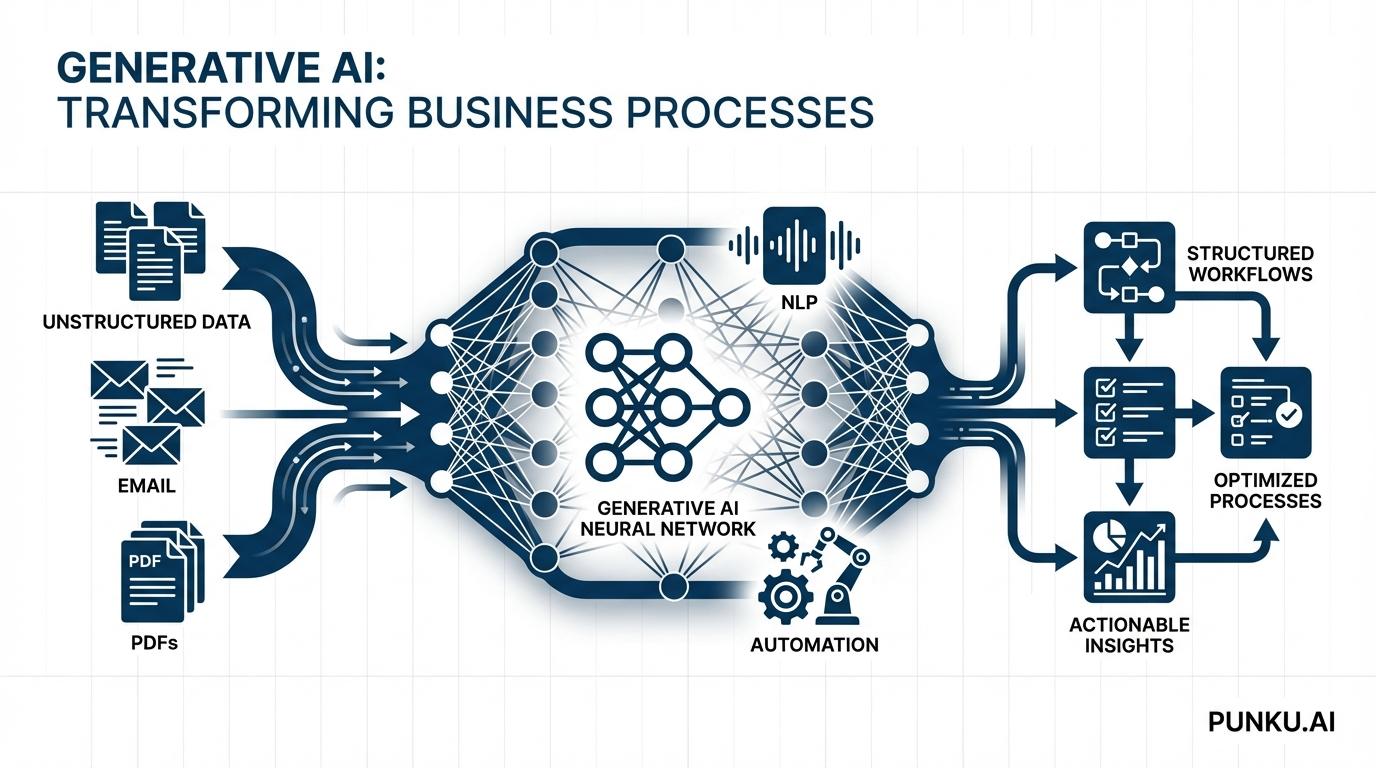
The landscape of Business Process Automation (BPA) is undergoing a fundamental paradigm shift. Traditionally dominated by Robotic Process Automation (RPA), which relies on rigid, rule-based scripts to mimic human actions, the industry is now transitioning toward Intelligent Automation (IA). This evolution is driven by the integration of Large Language Models (LLMs), Natural Language Processing (NLP), and Generative AI (GenAI). Unlike their predecessors, these technologies possess the capability to interpret unstructured data (which constitutes approximately 80% of enterprise information), generate complex workflows from natural language prompts, and adapt to dynamic business environments without extensive manual reprogramming.
This report investigates the mechanisms by which AI technologies are redefining BPA. Drawing on recent academic research, including the "Text2Workflow" methodology and studies on Natural Language AI models, and analyzing industry-leading tools from Microsoft, UiPath, Appian, and Automation Anywhere, this article provides a comprehensive overview of the current state of AI-driven automation. The findings suggest that the convergence of cognitive AI and automation is not merely an incremental improvement but a structural transformation that bridges the gap between human reasoning and machine efficiency.
1. The Evolution of Automation: From RPA to Intelligent Automation
1.1 The Limitations of Traditional RPA
Robotic Process Automation (RPA) has long been the standard for automating repetitive, high-volume tasks. However, its efficacy is inherently limited by its dependence on structured data and predefined rules. As noted in recent academic literature, traditional RPA struggles with complex decision-making and lacks the flexibility to handle exceptions or unstructured inputs [1, 2]. It requires expert knowledge to script workflows, creating a bottleneck where business users must rely on technical developers to implement even simple automations [1].
1.2 The Rise of Intelligent Automation (IA)
Intelligent Automation (IA) represents the fusion of RPA with cognitive technologies, specifically Machine Learning (ML) and NLP. This combination allows systems to move beyond simple execution to "thinking" and "learning." According to research by Chowdhury (2025), the integration of models such as GPT, BERT, and LLaMA enables enterprises to bridge the gap between human reasoning and machine efficiency [3, 4]. These models allow automation systems to process unstructured data, interpret user intent, and respond intelligently, thereby reducing dependency on manual intervention and minimizing human error [3].
2. The Challenge of Unstructured Data
2.1 The "80% Problem"
A critical barrier to traditional automation has been the prevalence of unstructured data, emails, PDFs, images, and free-text documents, which makes up nearly 80% of all enterprise data [5]. Conventional software requires data to be in structured formats (rows and columns) to process it effectively.
2.2 AI-Driven Solutions: Intelligent Document Processing (IDP)
Modern AI tools utilize Intelligent Document Processing (IDP) to convert this unstructured information into structured, actionable formats.
- Contextual Understanding: Unlike simple keyword matching, NLP models incorporate deep contextual understanding. They can perform text summarization, sentiment analysis, and information extraction to transform vast amounts of unstructured data into insights [3, 6].
- Generative Interpretation: Tools like UiPath's Autopilot and Clipboard AI use generative AI to understand the context of documents and screens, allowing them to copy and paste complex data between applications even when field labels do not match perfectly [7, 8].
3. Theoretical Frameworks: Academic Advances in AI Automation
3.1 Text2Workflow: Generating Actionable Steps from Natural Language
A significant academic development in this field is the "Text2Workflow" method introduced by Minkova et al. (2024). This research proposes a generalized solution for automating business processes by translating natural language user requests into executable workflows represented in JavaScript Object Notation (JSON) format [1, 9].
- Methodology: The system leverages the decision-making and instruction-following capabilities of LLMs to interpret a user's request (e.g., "Organize a meeting with the sales team") and map it to a sequence of API calls or executable steps [1].
- Significance: This approach democratizes automation, allowing non-technical users to visualize and execute workflows with minimal manual intervention, effectively bypassing the need for complex coding or expert RPA knowledge [2, 10].
3.2 The Influence of Natural Language Models
Chowdhury's research highlights that models like LLaMA and GPT extend beyond traditional automation by incorporating human-like communication capabilities. When integrated with Business Intelligence (BI) and RPA, these models enable "adaptive workflows" that continuously learn from interactions and adjust processes in real-time [3]. This capability is essential for communication-centric tasks, such as customer service interactions and internal operational coordination [4].
4. Industry Implementation: Leading AI-Driven BPA Tools
The theoretical capabilities of GenAI are currently being operationalized by major software vendors. The following analysis details how four leading platforms are integrating these technologies.
4.1 Microsoft Power Automate: Copilot
Microsoft has embedded its "Copilot" generative AI across the Power Automate ecosystem, fundamentally changing how flows are built and managed.
- Natural Language to Flow: Users can describe a desired automation in plain English (e.g., "When a form is submitted, save the response to SharePoint and email the team"), and Copilot generates the corresponding cloud flow structure [11, 12].
- Desktop Automation: In Power Automate for Desktop, Copilot allows users to generate scripts and analyze flow activity using natural language, democratizing access to complex desktop automation tasks [13, 14].
- Process Mining: Copilot assists in the ingestion and analysis of process data, summarizing findings quantitatively and qualitatively to identify bottlenecks [11].
4.2 UiPath: Autopilot and Clipboard AI
UiPath has introduced "Autopilot," a suite of AI-powered experiences designed to infuse GenAI into every layer of their Business Automation Platform.
- Developer Productivity: Autopilot for developers uses NLP to create workflows and generate expressions. Early adoption data suggests a 70% acceptance rate for these AI-generated suggestions, significantly speeding up development for less experienced users [15].
- Clipboard AI: This feature addresses the unstructured data challenge by using AI to intelligently copy and paste data between disparate applications and documents, understanding the semantic relationship between fields rather than just their position [7, 8].
- Testing: Autopilot for Test Suite generates tests from requirements and provides actionable insights from execution results, accelerating the quality assurance lifecycle [15].
4.3 Appian: AI Copilot and Data Fabric
Appian focuses on a "Private AI" strategy, ensuring enterprise data remains secure while leveraging generative capabilities.
- Interface Generation: Appian AI Copilot can convert PDF forms into interactive digital interfaces, utilizing generative AI to digitize legacy processes rapidly [16, 17].
- Data Fabric Integration: The AI Copilot allows users to query the organization's "Data Fabric" using natural language to uncover patterns and generate reports, effectively acting as a conversational interface for business intelligence [18].
- Self-Service Analytics: Business users can generate reports and gain real-time insights without needing to understand the underlying database schemas [19].
4.4 Automation Anywhere: Automation Co-Pilot
Automation Anywhere positions its "Automation Co-Pilot" as an embedded assistant for business users.
- Process Reasoning Engine (PRE): This technology allows users to trigger multi-step workflows and make decisions using natural language. It is designed to orchestrate agents across systems to drive business outcomes [20].
- Embedded Experience: The tool integrates directly into enterprise applications (like Microsoft Teams), allowing users to execute bots and manage approvals without switching contexts [21, 22].
5. Market Impact and Future Trends
5.1 Market Growth
The shift toward Intelligent Process Automation (IPA) is driving significant market expansion. Reports indicate that the global IPA market is projected to grow at a Compound Annual Growth Rate (CAGR) ranging from 14.3% to 23.7% over the next decade [23, 24]. The market size, valued at approximately $15-30 billion in 2024, is expected to exceed $160 billion by 2032 [23].
5.2 Key Drivers
- Democratization of Automation: By allowing natural language inputs (as seen in Text2Workflow and Microsoft Copilot), organizations are empowering "citizen developers" to create automations, reducing the backlog of IT requests [13, 25].
- Operational Efficiency: AI-driven automation operates 24/7 and can scale to handle massive workloads, significantly reducing operational costs and processing times [26].
- Strategic Decision Making: Beyond execution, AI tools now provide predictive analytics and decision support, transforming BPA from a tactical tool into a strategic asset [27, 28].
6. Conclusion
The integration of AI technologies into Business Process Automation marks a definitive transition from the era of "doing" to the era of "thinking." Traditional RPA, while effective for rote tasks, is being superseded by Intelligent Automation platforms that can read, reason, and respond.
Academic research validates this shift, demonstrating that Large Language Models can successfully translate human intent into executable machine workflows (Text2Workflow) and process the vast ocean of unstructured data that previously eluded automation (Chowdhury). Industry leaders like Microsoft, UiPath, Appian, and Automation Anywhere have rapidly operationalized these concepts, providing tools that allow users to build automations through conversation and interpret complex documents with near-human comprehension.
As organizations continue to adopt these tools, the focus will shift from simply automating tasks to redesigning business processes entirely, leveraging AI to uncover inefficiencies and drive strategic innovation.
Platform Comparison: AI-Driven BPA Features
| Platform | AI Feature | Key Capability |
|---|---|---|
| Microsoft Power Automate | Copilot | Natural language to flow generation |
| UiPath | Autopilot + Clipboard AI | Semantic data copy/paste, workflow generation |
| Appian | AI Copilot | PDF to interface conversion, Data Fabric queries |
| Automation Anywhere | Automation Co-Pilot | Process Reasoning Engine, Teams integration |
References
- Minkova, L., et al. (2024). From Words to Workflows: Automating Business Processes. arXiv:2412.03446. arxiv.org
- ResearchGate. (2024). From Words to Workflows: Automating Business Processes. researchgate.net
- Chowdhury, H. (2025). The Influence Of Natural Language AI Models On Enterprise Process Automation. International Journal of Science, Engineering and Technology. ijset.in
- ResearchGate. (2025). The influence of natural language AI models on enterprise process automation. researchgate.net
- Rannsolve. (2025). How AI Transforms Unstructured Data Management for Businesses. rannsolve.com
- IJSET. (2025). Abstract: The Influence Of Natural Language AI Models On Enterprise Process Automation. abcdindex.com
- Business Wire. (2023). UiPath Announces Autopilot to Make AI at Work a Reality. businesswire.com
- SiliconANGLE. (2023). UiPath launches Autopilot AI assistant for every business worker. siliconangle.com
- Minkova, L., et al. (2024). Text2Workflow Methodology. arXiv. arxiv.org
- arXiv. (2024). From Words to Workflows: Automating Business Processes (Full Text). arxiv.org
- Microsoft Learn. (2025). Copilot in Power Automate overview. microsoft.com
- Microsoft Learn. (2025). Create a cloud flow using Copilot. microsoft.com
- Microsoft Learn. (2025). Create desktop flows using natural language with Copilot. microsoft.com
- Azure Curve. (2023). New Functionality in Microsoft Power Automate: Create desktop flows using natural language. azurecurve.co.uk
- ERP Today. (2024). UiPath announces features to streamline automation with Autopilot and GenAI. erp.today
- IT Brief. (2023). Appian Process Platform adds Appian AI Copilot. itbrief.com.au
- SD Times. (2023). Appian AI Copilot delivers practical value to boost developer productivity. sdtimes.com
- Appian Documentation. (2025). AI Copilot for Users. appian.com
- Appian Documentation. (2025). Appian AI Copilot. appian.com
- Automation Anywhere. (n.d.). Automation Co-Pilot Product Page. automationanywhere.com
- Automation Anywhere Documentation. (2019). Automation Co-Pilot for Business Users. automationanywhere.com
- Automation Anywhere (YouTube). (2024). Demonstration of Co-Pilot and Gen AI. youtube.com
- Data Bridge Market Research. (2024). Global Natural Language Processing (NLP) Intelligent Process Automation Market. databridgemarketresearch.com
- GM Insights. (2024). Intelligent Process Automation Market Size. gminsights.com
- Newline. (2025). Business Processes with AI Automation. newline.co
- Boomi. (2024). AI Transforming Process Automation. boomi.com
- Centric Consulting. (2024). The Role of AI in Streamlining Business Processes. centricconsulting.com
- ResearchGate. (2025). From Manual to AI-Driven: The Evolution of Business Process Automation. researchgate.net
Related Articles

Best AI for Job Applications 2026: Cover Letters & Resume Optimization
Which AI is best for resumes and cover letters in 2026? An August data-backed comparison across natural prose, ATS matching, privacy, and speed.

Best AI for Math 2026: Which AI Calculates and Proves Best?
Which AI is the best for math in 2026? An August data-driven comparison by reasoning performance, BenchLM scores, pricing, and speed with practical tips for error-free proofs.

Best AI for Presentations 2026: Top Models Compared
Which AI is best for creating presentations in 2026? An August data-backed comparison across content quality, speed, and ecosystem integration for compelling slides and speaking notes.
Join 200+ Businesses Automating with PUNKU.AI
Stop drowning in repetitive tasks. Let AI handle the boring stuff while you focus on what matters.
Get StartedGet started instantly • Set up in minutes • Cancel anytime
Frequently Asked Questions
What is the difference between RPA and Intelligent Automation?
Traditional RPA uses rigid, rule-based scripts to mimic human actions on structured data. Intelligent Automation (IA) combines RPA with AI technologies like NLP and machine learning, enabling systems to process unstructured data, interpret intent, and adapt without manual reprogramming.
What is the "80% problem" in enterprise automation?
Approximately 80% of enterprise data is unstructured, emails, PDFs, images, and free-text documents. Traditional automation tools cannot process this data, creating a significant limitation that AI-powered Intelligent Document Processing (IDP) now addresses.
How does Text2Workflow technology work?
Text2Workflow uses Large Language Models to interpret natural language requests (like "Organize a meeting with the sales team") and automatically generate executable workflows in JSON format, eliminating the need for technical coding expertise.
Can non-technical users create automations with AI tools?
Yes. Modern platforms like Microsoft Power Automate, UiPath Autopilot, and Appian AI Copilot allow "citizen developers" to describe desired automations in plain English, with AI generating the corresponding workflow structures.
What is Intelligent Document Processing (IDP)?
IDP uses AI and NLP to extract, classify, and transform unstructured documents into structured, actionable data. Unlike simple OCR, IDP understands context, performs sentiment analysis, and handles documents even when field labels don't match perfectly.