From Inference Engines to Large Language Models: Tracing the Evolution of Natural Language Generation
Key Takeaways
Executive Summary
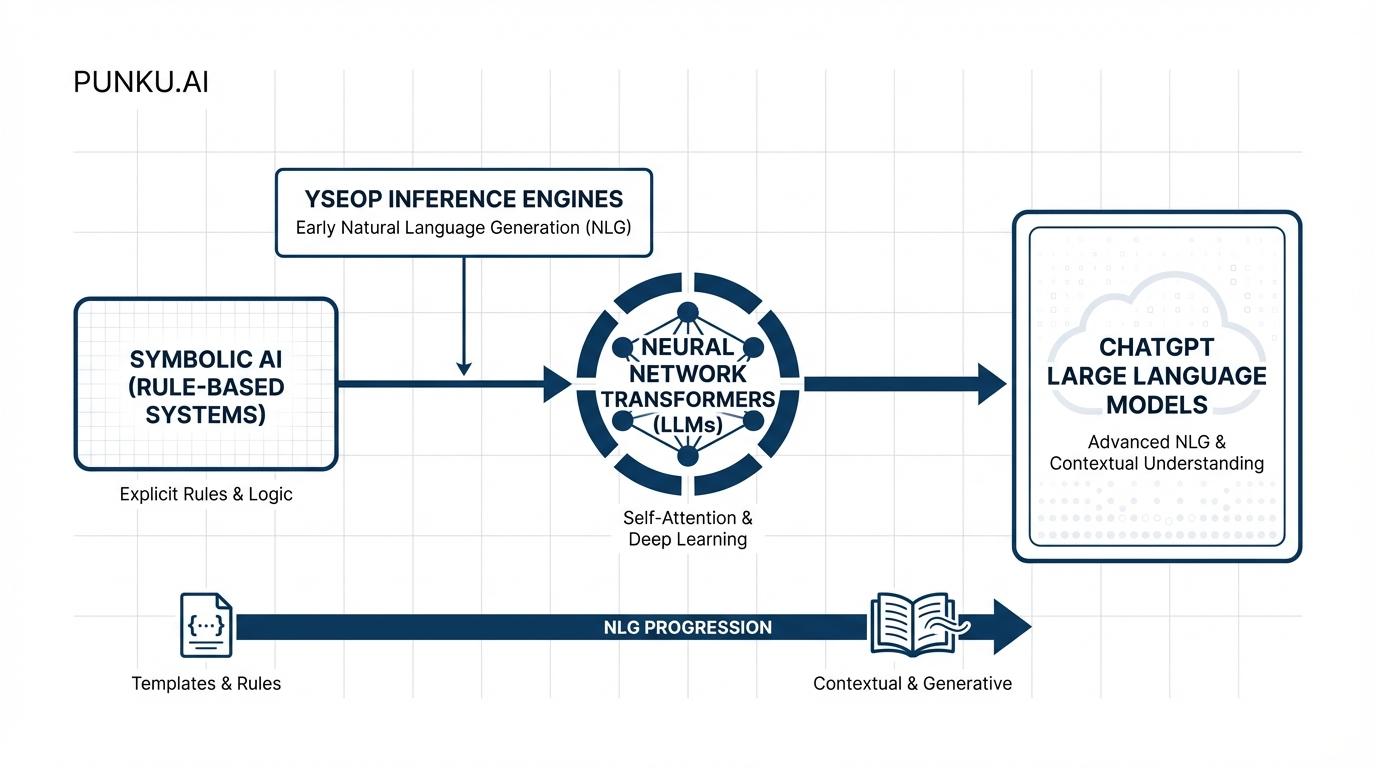
The evolution of Natural Language Generation (NLG) represents a technological odyssey from rigid, rule-based templates to the fluid, probabilistic creativity of modern Generative AI. For decades, the field was dominated by "Symbolic AI", systems governed by strict logic and pre-defined rules designed to convert structured data into human-readable text. Among the pioneers of this era was Yseop, a French software company founded in the early 2000s. While recent claims suggest Yseop "laid the groundwork" for ChatGPT, a forensic analysis of the technology reveals a more nuanced reality. Yseop championed the commercial viability of automated writing and pioneered "Data-to-Text" reasoning, but its core technology, the inference engine, differs fundamentally from the neural network architectures driving OpenAI's GPT series. This article investigates the history of commercial NLG, analyzes the technological divergence between Symbolic and Generative AI, and evaluates Yseop's specific contributions and current adaptation in the age of Large Language Models (LLMs).
1. The Dawn of Commercial Natural Language Generation (NLG)
Before the advent of Large Language Models (LLMs) like GPT-4, NLG was primarily a deterministic field. It focused on "Data-to-Text" generation, where the objective was to translate rows of structured data (spreadsheets, databases) into coherent narratives without human intervention [1, 2].
1.1 The "Smart Template" Era
In the mid-to-late 2000s, a cohort of companies emerged to commercialize NLG. These firms moved beyond simple "mail merge" techniques to create sophisticated systems capable of conditional logic (e.g., "If profit is up >5%, write 'strong growth'; otherwise, write 'marginal gains'").
- Automated Insights (founded 2007): Famous for its "Wordsmith" platform, this company partnered with the Associated Press to automate corporate earnings reports and sports recaps. Their approach allowed media outlets to scale content production massively [3, 4].
- Narrative Science (founded 2010): Originating from Northwestern University, their "Quill" platform focused on business intelligence, generating narratives from data visualizations. They were acquired by Salesforce/Tableau in 2021 [5].
- Arria NLG (founded 2012): A key player that acquired Data2Text, focusing on meteorology and industrial reporting [3].
1.2 Yseop's Entry and the "Inference Engine"
Yseop (pronounced 'Easy-Op') was established in 2000 by Alain Kaeser, a mathematician and researcher at the École Normale Supérieure Paris-Saclay [6, 7]. While American competitors often focused on media and sports, Yseop targeted complex, regulated industries like finance and pharmaceuticals.
Yseop's technological foundation was Symbolic AI. Kaeser developed an "inference engine", a system that applies logical rules to a knowledge base to deduce new information [7, 8]. Unlike modern probabilistic models that predict the next word based on statistical likelihood, Yseop's software was deterministic. It required explicit programming of business rules and linguistic structures. If the system generated a sentence, it was because a specific rule dictated it, ensuring 100% accuracy and auditability, a critical requirement for regulatory reporting [9, 10].
2. Technological Divergence: Symbolic AI vs. Generative AI
To evaluate claims regarding Yseop's influence on ChatGPT, one must understand the fundamental schism in AI development.
2.1 Symbolic AI (The Yseop Approach)
Symbolic AI, often called "Good Old-Fashioned AI" (GOFAI), relies on human-readable representations of logic.
- Mechanism: It uses explicit rules (If X, then Y) and ontologies.
- Strengths: High accuracy, explainability (you know exactly why the AI wrote what it wrote), and hallucination-free output.
- Limitations: It is rigid, requires heavy manual setup (coding rules), and struggles with open-ended creative tasks [10, 11].
2.2 Connectionist AI and Transformers (The ChatGPT Approach)
Modern Generative AI, including ChatGPT, arises from the "Connectionist" school, specifically Deep Learning.
- Mechanism: It uses neural networks trained on vast datasets to learn statistical patterns. The introduction of the Transformer architecture by Google researchers in 2017 revolutionized this field, enabling models to track context over long sequences [12, 13].
- Strengths: Fluidity, creativity, and the ability to handle unstructured inputs.
- Limitations: "Black box" nature (hard to explain why it wrote something) and the propensity for "hallucinations" (generating plausible but false information) [9, 14].
3. Investigating the Claim: Did Yseop "Lay the Groundwork" for ChatGPT?
Wikipedia entries and certain industry narratives claim that Yseop "laid the groundwork for Chat GPT and Generative AI" [6]. An objective analysis suggests this claim is conceptually true but technologically distinct.
3.1 The Argument for Precedence
Yseop was undeniably a pioneer in normalizing the concept of automated content creation.
- Market Education: Long before ChatGPT, Yseop demonstrated to enterprises that software could write human-like reports. They proved that "computer-written text" could be trusted in high-stakes environments like clinical trials and financial auditing [7, 15].
- Data-to-Text: Yseop solved the "Data-to-Text" problem (turning structured data into narrative) years before LLMs became proficient at it. In this sense, they prepared the market and the use cases that Generative AI would later expand upon [3, 16].
3.2 The Technological Disconnect
However, there is no direct architectural lineage between Yseop's inference engine and OpenAI's GPT models.
- Different Ancestry: ChatGPT is a descendant of statistical language models (n-grams -> RNNs -> Transformers) [1, 17]. Yseop is a descendant of Expert Systems and Logic Programming [8, 18].
- The "Hallucination" Gap: Yseop's founder, Alain Kaeser, and current leadership have explicitly contrasted their technology with ChatGPT. They highlight that ChatGPT is probabilistic (guessing the next word), whereas Yseop's historical tech is deterministic (reasoning based on facts) [9, 14].
- Scholarly Consensus: Academic reviews of the field classify Yseop alongside "Traditional data-to-text NLG companies" like Automated Insights, distinct from the "Neural" or "Generative" revolution triggered by Transformers [3].
Therefore, Yseop did not lay the technical groundwork (i.e., the algorithms) for ChatGPT. Instead, it laid the commercial and conceptual groundwork by establishing the industry of automated reporting.
4. The Modern Pivot: Composite AI and the "Copilot"
The release of ChatGPT in late 2022 disrupted the traditional NLG market. "Smart templates" suddenly appeared obsolete compared to the fluidity of LLMs. However, Yseop adapted by pivoting to a "Composite AI" or "Hybrid" approach, specifically for regulated industries [10, 11].
4.1 The Problem with Pure GenAI in Pharma
In the pharmaceutical industry, accuracy is non-negotiable. A Clinical Study Report (CSR) submitted to the FDA cannot contain a single "hallucinated" statistic. This renders out-of-the-box ChatGPT unsuitable for such tasks due to its probabilistic nature [9, 14].
4.2 Yseop's Hybrid Solution
Yseop now positions itself as a "Copilot" for life sciences, integrating its legacy Symbolic AI with modern LLMs.
- Symbolic AI Role: Handles the data analysis, logic, and factual verification. It ensures the numbers in the text match the numbers in the dataset [10, 11].
- Generative AI Role: Handles the fluency and variation of the text, making the output read more naturally than the rigid templates of the past [9, 14].
- Success Cases: This hybrid approach has been adopted by major pharmaceutical companies like Sanofi, Eli Lilly, and Novartis to automate clinical trial documentation, reducing writing time from weeks to days [15, 19, 20].
5. Conclusion
The history of Natural Language Generation is a tale of two technologies: the precise, rule-based systems of the past and the creative, probabilistic models of the present. Yseop stands as a critical bridge between these eras. While it is an overstatement to claim Yseop provided the architectural foundation for ChatGPT, the company's role as a pioneer cannot be understated. By proving that machines could reason and write, Yseop prepared the global enterprise landscape for the AI revolution. Today, by fusing its proprietary inference engines with modern LLMs, Yseop demonstrates that the future of industrial AI likely lies not in choosing between Symbolic or Generative approaches, but in combining them to achieve both creativity and accuracy.
NLG Technology Comparison
| Aspect | Symbolic AI (Yseop) | Generative AI (ChatGPT) |
|---|---|---|
| Mechanism | Explicit rules (If X, then Y) | Neural networks, statistical patterns |
| Accuracy | 100% (deterministic) | Varies (probabilistic) |
| Explainability | Full (auditable rules) | Limited ("black box") |
| Hallucination Risk | None | Significant |
| Creativity | Limited | High |
| Setup Effort | High (manual rule coding) | Low (pre-trained models) |
| Best For | Regulated industries, compliance | Creative content, general use |
Timeline of Commercial NLG
| Year | Milestone |
|---|---|
| 2000 | Yseop founded by Alain Kaeser |
| 2007 | Automated Insights launches Wordsmith |
| 2010 | Narrative Science founded (Northwestern University) |
| 2012 | Arria NLG founded |
| 2017 | Google introduces Transformer architecture |
| 2021 | Narrative Science acquired by Salesforce/Tableau |
| 2022 | ChatGPT released, disrupting traditional NLG market |
| 2023+ | Yseop pivots to Composite AI for pharma |
References
- Lark. (2023). Evolution of the Concept of Natural Language Generation. larksuite.com
- Devopedia. (2020). Natural Language Generation. devopedia.org
- Dale, R. (2023). Navigating the text generation revolution: Traditional data-to-text NLG companies and the rise of ChatGPT. Natural Language Engineering. Cambridge Core. cambridge.org
- Automated Insights. (2018). The History of Natural Language Generation. Medium. medium.com
- Wikipedia. Narrative Science. wikipedia.org
- Wikipedia. Yseop. wikipedia.org
- Yseop. Alain Kaeser Leadership Profile. yseop.com
- Yseop. (2017). Popular Tech for Automation in Finance: Top 3 Expert Systems. yseop.com
- Yseop. (2023). Impact of Generative AI on Regulated Industries. yseop.com
- Promptloop. *What does Yseop do? promptloop.com
- Yseop. Preclinical Document Automation. yseop.com
- Makebot. (2025). The Evolution from NLP to Generative AI Chatbots in 2025. makebot.ai
- Arxiv. (2024). A Step Beyond: New Considerations Triggered by Generative AI. arxiv.org
- Yseop. (2023). Yseop Copilot vs Traditional LLMs. yseop.com
- FirstWord Pharma. (2022). Yseop history natural language generation. firstwordpharma.com
- Vizologi. (2024). Different Approaches to Natural Language Generation. vizologi.com
- YouTube/Telecom Paris. (2025). Evolution of Language Models. youtube.com
- Quora. (2023). What is technology behind AI. quora.com
- Yseop. (2025). Yseop Strengthening Leadership in Gen AI for Life Sciences. yseop.com
- Yseop. Company Homepage and Solutions. yseop.com
- Yseop. (2023). Yseop Announces Strategic Investment and Celebrates Milestone. yseop.com
- Yseop. (2024). Yseop Copilot vs. GenAI Technologies. yseop.com
Related Articles

Best AI for Job Applications 2026: Cover Letters & Resume Optimization
Which AI is best for resumes and cover letters in 2026? An August data-backed comparison across natural prose, ATS matching, privacy, and speed.

Best AI for Math 2026: Which AI Calculates and Proves Best?
Which AI is the best for math in 2026? An August data-driven comparison by reasoning performance, BenchLM scores, pricing, and speed with practical tips for error-free proofs.

Best AI for Presentations 2026: Top Models Compared
Which AI is best for creating presentations in 2026? An August data-backed comparison across content quality, speed, and ecosystem integration for compelling slides and speaking notes.
Join 200+ Businesses Automating with PUNKU.AI
Stop drowning in repetitive tasks. Let AI handle the boring stuff while you focus on what matters.
Get StartedGet started instantly • Set up in minutes • Cancel anytime
Frequently Asked Questions
Did Yseop invent the technology behind ChatGPT?
No. Yseop uses Symbolic AI (rule-based inference engines), while ChatGPT uses Connectionist AI (neural networks with Transformer architecture). They represent fundamentally different approaches to AI. Yseop pioneered the commercial market for automated writing, but did not contribute the algorithms used in GPT models.
What is the difference between Symbolic and Generative AI?
Symbolic AI uses explicit, human-coded rules to produce deterministic, explainable outputs with no hallucination risk. Generative AI uses neural networks trained on vast datasets to produce probabilistic, creative outputs that may contain factual errors ("hallucinations").
Why can't pharmaceutical companies use ChatGPT directly for clinical documentation?
Clinical Study Reports submitted to regulators like the FDA require 100% factual accuracy. ChatGPT's probabilistic nature means it can generate plausible but false information. Regulated industries need deterministic systems that guarantee accuracy and auditability.
What is Composite AI or Hybrid AI?
Composite AI combines multiple AI techniques, in Yseop's case, merging Symbolic AI (for accuracy and verification) with Generative AI (for fluency and natural language). This hybrid approach delivers both the reliability of rule-based systems and the readability of modern LLMs.
Which major companies use Yseop's hybrid approach?
Pharmaceutical companies including Sanofi, Eli Lilly, and Novartis have adopted Yseop's hybrid solution for automating clinical trial documentation, reportedly reducing writing time from weeks to days while maintaining regulatory compliance.
References
- <a id="ref-1"></a>Lark. (2023). Evolution of the Concept of Natural Language Generation. larksuite.com
- <a id="ref-2"></a>Devopedia. (2020). Natural Language Generation. devopedia.org
- <a id="ref-3"></a>Dale, R. (2023). Navigating the text generation revolution: Traditional data-to-text NLG companies and the rise of ChatGPT. Natural Language Engineering. Cambridge Core. cambridge.org
- <a id="ref-4"></a>Automated Insights. (2018). The History of Natural Language Generation. Medium. medium.com
- <a id="ref-5"></a>Wikipedia. Narrative Science. wikipedia.org
- <a id="ref-6"></a>Wikipedia. Yseop. wikipedia.org
- <a id="ref-7"></a>Yseop. Alain Kaeser Leadership Profile. yseop.com
- <a id="ref-8"></a>Yseop. (2017). Popular Tech for Automation in Finance: Top 3 Expert Systems. yseop.com
- <a id="ref-9"></a>Yseop. (2023). Impact of Generative AI on Regulated Industries. yseop.com
- <a id="ref-10"></a>Promptloop. *What does Yseop do? promptloop.com
- <a id="ref-11"></a>Yseop. Preclinical Document Automation. yseop.com
- <a id="ref-12"></a>Makebot. (2025). The Evolution from NLP to Generative AI Chatbots in 2025. makebot.ai
- <a id="ref-13"></a>Arxiv. (2024). A Step Beyond: New Considerations Triggered by Generative AI. arxiv.org
- <a id="ref-14"></a>Yseop. (2023). Yseop Copilot vs Traditional LLMs. yseop.com
- <a id="ref-15"></a>FirstWord Pharma. (2022). Yseop history natural language generation. firstwordpharma.com
- <a id="ref-16"></a>Vizologi. (2024). Different Approaches to Natural Language Generation. vizologi.com
- <a id="ref-17"></a>YouTube/Telecom Paris. (2025). Evolution of Language Models. youtube.com
- <a id="ref-18"></a>Quora. (2023). What is technology behind AI. quora.com
- <a id="ref-19"></a>Yseop. (2025). Yseop Strengthening Leadership in Gen AI for Life Sciences. yseop.com
- <a id="ref-20"></a>Yseop. Company Homepage and Solutions. yseop.com
- <a id="ref-21"></a>Yseop. (2023). Yseop Announces Strategic Investment and Celebrates Milestone. yseop.com
- <a id="ref-22"></a>Yseop. (2024). Yseop Copilot vs. GenAI Technologies. yseop.com