Process-Driven Messaging Services: Architecting Interoperability via Standard and Workflow Objects
Key Takeaways
Key Points
- Process-Driven Messaging Service (PDMS) is an architectural paradigm that embeds business logic (triggers, jobs, and workflows) directly into the messaging layer, distinguishing it from passive data transport.
- Three Core Elements define this architecture: Standard Objects (representing static resources or devices), Workflow Objects (representing dynamic instances or cases), and Workflow (the orchestration logic).
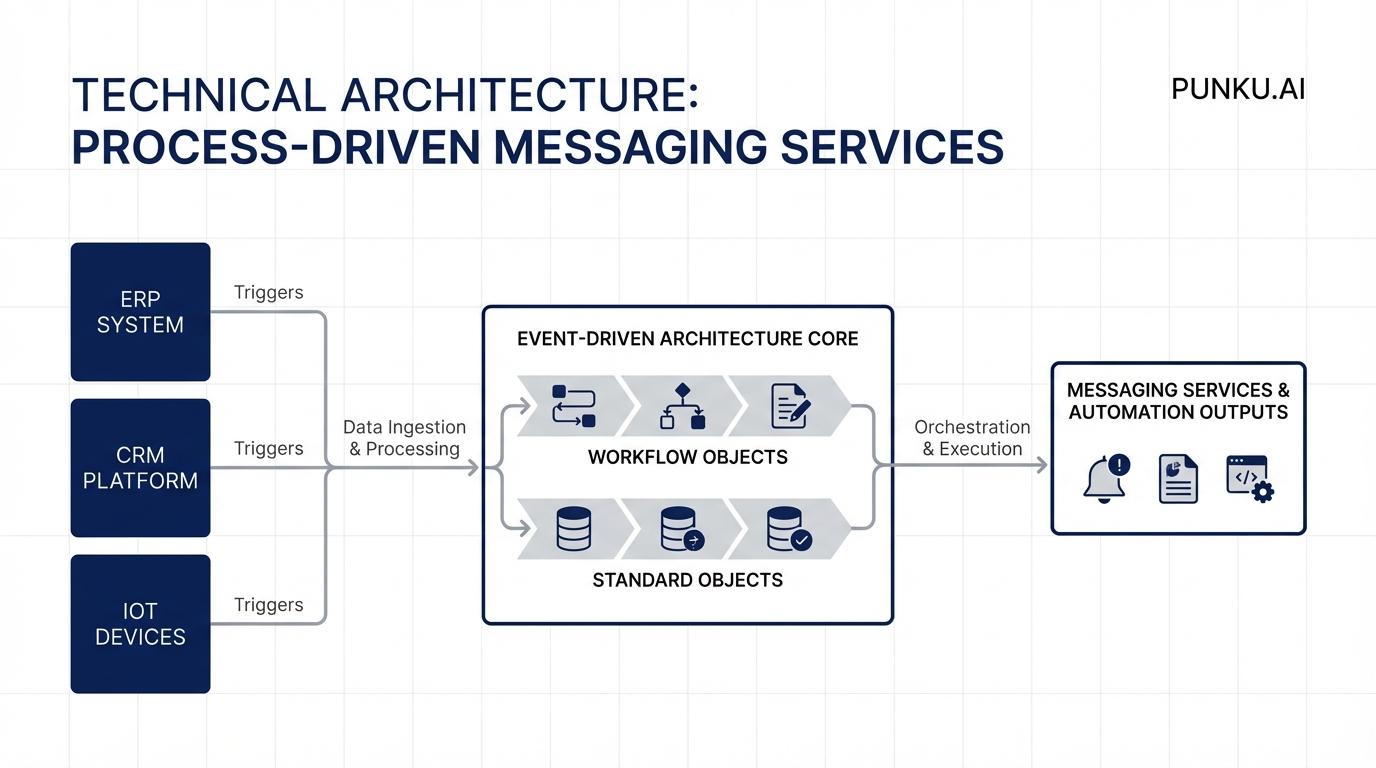
- Integration Capability: PDMS serves as a critical data exchange layer, enabling interoperability between disparate functional applications (ERP, CRM) and hardware devices (IoT, M2M) via Event-Driven Architecture (EDA).
- Standardization: The framework relies heavily on international standards, including ISO 9506 (Manufacturing Message Specification) for device objects, ISO 19510 (BPMN) for process modeling, and ISO/IEC 23090-8 for media workflow objects.
Executive Summary
In the contemporary landscape of enterprise architecture and industrial automation, the static exchange of data is no longer sufficient to maintain competitive agility. Organizations are increasingly adopting Process-Driven Messaging Services (PDMS), a sophisticated integration layer that elevates messaging from simple communication to intelligent orchestration. Unlike traditional message-oriented middleware (MOM) which focuses on the reliable delivery of packets, PDMS incorporates process awareness, allowing the messaging infrastructure to understand, route, and transform data based on the state of a business process.
This article provides an exhaustive analysis of PDMS, specifically dissecting the three fundamental elements identified in workflow management theory: Standard Objects, Workflow Objects, and Workflow. By synthesizing definitions from ISO standards (including ISO 9506, ISO 19510, and ISO/IEC 23090-8) and authoritative business process references, this report elucidates how these elements function as the connective tissue between heterogeneous software applications and physical devices. The analysis demonstrates that by mapping end-to-end process workflows within the API or messaging layer, organizations can achieve a decoupled yet highly cohesive operational environment, facilitating advanced capabilities such as Robotic Process Automation (RPA) and Machine-to-Machine (M2M) integration.
1. Introduction to Process-Driven Messaging Services (PDMS)
1.1 Definition and Core Concept
A Process-Driven Messaging Service (PDMS) is defined as a service architecture where jobs and triggers are assembled to create a workflow for a message, effectively treating the workflow itself as a process [1]. Unlike traditional messaging systems that act as passive pipes for data transmission, a PDMS is "process-oriented," meaning the logic of how and when data moves is intrinsic to the messaging service itself [1].
At its core, PDMS functions as an optimized data exchange layer. By mapping an end-to-end process workflow, organizations can build integrations between individual platforms using the PDMS as the logic engine [2, 3, 4]. This approach allows for the construction of processes using triggers, jobs, and workflows exposed via public APIs, enabling disparate systems, from mobile devices to legacy mainframes, to interact within a unified process framework [1, 2].
1.2 The Shift from Data-Centric to Process-Centric Messaging
Historically, integration focused on data replication or point-to-point connections. PDMS represents a paradigm shift toward Event-Driven Architecture (EDA). In this model, systems do not merely issue requests and wait for responses; rather, they transmit events among loosely coupled components [1]. The PDMS observes these events and reacts dynamically based on pre-configured workflow logic.
This architecture is essential for modern automation. As noted in industry roundtables, automating complex business processes requires connectors to fit systems together with a data exchange layer [2]. PDMS provides this layer, allowing for the deployment of software agents and Robotic Process Automation (RPA) to handle repetitive tasks while ensuring data integrity across the ecosystem [2, 3].
2. The Three Elements of PDMS Architecture
Research indicates that software suppliers utilizing PDMS technology structure their solutions around three distinct elements: Standard Objects, Workflow Objects, and Workflow [5, 6]. Understanding the precise definitions and roles of these elements is critical for implementing effective workflow management systems.
2.1 Element 1: Standard Objects
Standard Objects represent the static or persistent entities within a system that the workflow acts upon. They are the "nouns" of the system, the resources, devices, or fundamental data structures that exist independently of any specific process instance.
2.1.1 Definition in Industrial Automation (ISO 9506)
In the context of device integration and Machine-to-Machine (M2M) communications, the definition of Standard Objects is rigorously provided by ISO 9506, known as the Manufacturing Message Specification (MMS) [7].
According to ISO 9506, a device (such as a Programmable Logic Controller or Robot) must contain a set of Standard Objects on which operations like read, write, and event signaling can be executed [7]. The primary Standard Object is the Virtual Manufacturing Device (VMD), which serves as a container for all other objects, including:
- Variables: Typed data values representing sensor readings or state.
- Domains: Memory areas for program storage.
- Semaphores: Mechanisms for resource control.
- Journals: Logs of device activity [7, 8].
In a PDMS, a "Job" often affects these Standard Objects (e.g., altering metadata in a unit or changing a variable in a VMD) [1]. This standardization allows the messaging service to interact with hardware from different vendors using a unified vocabulary.
2.1.2 Definition in Business Applications (CRM/ERP)
In business software contexts (e.g., Salesforce, SAP), Standard Objects refer to the out-of-the-box database tables provided by the platform to manage common business entities [9]. Examples include:
- Accounts: Representing organizations.
- Contacts: Representing individuals.
- Opportunities: Representing potential sales.
- Cases: Representing service issues [9, 10].
These objects come with predefined fields, behaviors, and relationships, providing a stable foundation upon which workflows can be built [11]. In a PDMS, a message might trigger an update to a "Contact" Standard Object, ensuring that the state of the customer record is consistent across all integrated applications.
2.2 Element 2: Workflow Objects
Workflow Objects (sometimes referred to as "cases," "tokens," or "workflow instances") represent the dynamic data that moves through the process. Unlike Standard Objects, which are persistent resources, Workflow Objects are transient or lifecycle-dependent entities that accumulate state and data as they progress through the workflow.
2.2.1 Definition in ISO/IEC 23090-8
A precise technical definition of a Workflow Object is found in ISO/IEC 23090-8 (Information technology, Coded representation of immersive media, Part 8: Network based media processing). This standard defines a Workflow Object (WO) as a "workflow description in JSON format" [12, 13].
In this context, the Workflow Object encapsulates the logic and data requirements for a specific processing task (e.g., a media transcoding pipeline). It serves as the blueprint for the instance, carrying the instructions and metadata required by the network-based media processing engine to execute the task [12].
2.2.2 Definition in Workflow Management Systems
In broader workflow management theory, a Workflow Object is often described as a container that accumulates data produced during the process and documents its progress [14].
- State Accumulation: As a workflow progresses (e.g., from "New" to "Approved" to "Archived"), the Workflow Object is updated to reflect these status changes [15].
- Data Payload: It carries the specific payload (e.g., the invoice details, the patient ID, or the support ticket information) required by the jobs and triggers within the PDMS [15].
- Differentiation: While a Standard Object might be the "Customer Database," the Workflow Object is the specific "Onboarding Request" for a new customer.
2.3 Element 3: Workflow
The Workflow is the orchestrated pattern of activity, the "verb" or the logic map that dictates how Standard Objects are manipulated and how Workflow Objects transition between states.
2.3.1 Definition and ISO 19510 (BPMN)
ISO 19510, which ratifies the Business Process Model and Notation (BPMN) 2.0, provides the authoritative definition and graphical notation for workflows [16].
- Definition: A workflow is a generic term for orchestrated and repeatable patterns of activity, enabled by the systematic organization of resources into processes that transform materials, provide services, or process information [5].
- PDMS Context: In a PDMS, a workflow is a "container" that wraps triggers and jobs together. It is a template for a business process that can be invoked repeatedly [1].
2.3.2 Components of a PDMS Workflow
According to PDMS architecture, a workflow consists of:
- Triggers: The event that initiates the workflow (e.g., an incoming message, a database update, or a sensor reading) [1].
- Jobs: The specific tasks performed (e.g., sending an SMS, updating a Standard Object, or invoking an external API) [1].
- Logic: The conditional rules (gateways in BPMN) that determine the path of execution [16].
3. Integration Mechanisms: Connecting Applications and Devices
The primary value of PDMS lies in its ability to function as a Data Exchange Layer [2, 3]. By utilizing the three elements defined above, PDMS enables seamless integration between functional software applications and hardware devices.
3.1 Application-to-Application (A2A) Integration
PDMS facilitates A2A integration by decoupling the sender and receiver.
- Mechanism: An ERP system (Application A) updates a Standard Object (e.g., Inventory Level). This event acts as a Trigger for a PDMS Workflow. The workflow creates a Workflow Object (e.g., Restock Request) and executes a Job to send a purchase order to a Supplier System (Application B) via API [1, 2].
- Benefit: The logic resides in the messaging layer, not the applications. If the Supplier System changes, only the PDMS Job configuration needs updating, not the ERP core code.
3.2 Machine-to-Machine (M2M) and Device Integration
PDMS is particularly potent in Internet of Things (IoT) and industrial contexts.
- Mechanism: A sensor (Device A) detects a temperature anomaly. This is a "Trigger" in the PDMS. The PDMS references the Standard Object (the Virtual Manufacturing Device defined in ISO 9506) to understand the device's context [7]. It then initiates a Workflow that executes a Job to send a shutdown command to the Actuator (Device B) and an alert to a human operator via SMS (Application-to-Person) [1, 17].
- ISO 9506 Role: The use of MMS Standard Objects ensures that the PDMS can communicate with the device regardless of the manufacturer, provided they adhere to the standard [18].
3.3 The Role of APIs and Connectors
To automate these processes, connectors are required to fit systems together. PDMS platforms often expose all triggers and jobs via a public API [1]. This allows developers to build workflows programmatically, where the workflow in the API acts as the data exchange layer. This is crucial for mobile device integration, where a mobile app can trigger a complex backend workflow via a simple API call [2, 3].
4. Standards and Compliance Reference
To ensure interoperability, PDMS implementations should align with the following international standards:
| Standard | Title | Relevance to PDMS |
|---|---|---|
| ISO 9506 | Manufacturing Message Specification (MMS) | Defines Standard Objects (VMDs, Variables) for device messaging and control [7]. |
| ISO 19510 | Business Process Model and Notation (BPMN) | Defines the notation and semantics for the Workflow element, ensuring process logic is standardized [16]. |
| ISO/IEC 23090-8 | Network-based Media Processing | Defines Workflow Objects (WO) and workflow description documents for media processing pipelines [12]. |
| ISO 20022 | Financial Services Messaging | Provides a standard data dictionary for message content, often used within the payload of a PDMS in financial sectors [19]. |
| ISO 8583 | Financial Transaction Card Originated Messages | Defines the message format and data elements for payment card transactions, a specific type of process-driven message [20]. |
5. Conclusion
Process-Driven Messaging Services represent the evolution of workflow management from static data logging to dynamic, event-driven orchestration. By structuring integration around Standard Objects (the resources), Workflow Objects (the active cases), and Workflows (the logic), PDMS provides a robust framework for connecting the digital and physical worlds.
The reliance on authoritative standards, specifically ISO 9506 for device objects and ISO 19510 for process modeling, ensures that these services remain interoperable and scalable. As organizations continue to deploy complex ecosystems involving IoT devices, mobile platforms, and legacy enterprise software, the PDMS architecture offers the necessary logic layer to automate processes, optimize data exchange, and enable the next generation of robotic and intelligent automation.
PDMS Architecture Components
| Component | Role | Examples |
|---|---|---|
| Standard Objects | Static resources the workflow acts upon | VMD, Variables, Accounts, Contacts |
| Workflow Objects | Dynamic instances that accumulate state | Onboarding Request, Restock Order |
| Triggers | Events that initiate workflows | Database update, sensor reading, API call |
| Jobs | Specific tasks within workflows | Send SMS, update CRM, invoke API |
| Logic | Conditional rules for execution paths | BPMN gateways, decision points |
References
- Wikipedia. (n.d.). Process driven messaging service. wikipedia.org
- HotTopics. (2025). Process automation: streamlining workflows and systems. hottopics.ht
- Imperium Apps. (2019). How automation is creating waves for the customer experience industry. imperiumapp.com
- Scribd. (n.d.). Business process automation activity. scribd.com
- Wikipedia. (n.d.). Workflow. wikipedia.org
- Website Files. (n.d.). Workflow Technology PDF. website-files.com
- Wikipedia. (n.d.). Manufacturing Message Specification. wikipedia.org
- Xelas Energy. (n.d.). MMS Protocol Stack. xelasenergy.com
- Bacancy Technology. (2025). Salesforce Custom Objects. bacancytechnology.com
- PhoneIQ. (2021). Salesforce Standard Objects. phoneiq.co
- The Knowledge Academy. (2025). Salesforce Objects. theknowledgeacademy.com
- ISO/IEC. (2020). ISO/IEC FDIS 23090-8. iteh.ai
- ISO/IEC. (2021). ISO/IEC 23090-8:2020. iteh.ai
- Hemel, Z., et al. (2008). WebWorkFlow: An Object-Oriented Workflow Modeling Language. eelcovisser.org
- Alloy Software. (n.d.). What is Workflow Management? alloysoftware.com
- Wikipedia. (n.d.). Business Process Model and Notation. wikipedia.org
- Wikipedia. (n.d.). Machine to machine. wikipedia.org
- Studylib. (n.d.). Manufacturing Messaging Specification. studylib.net
- AWS Architecture Blog. (2023). Event-Driven Architecture for ISO 20022 Messaging Workflows. amazon.com
- Wikipedia. (n.d.). ISO 8583. wikipedia.org
Related Articles
Best AI for Job Applications 2026: Cover Letters & Resume Optimization
Which AI is best for resumes and cover letters in 2026? An August data-backed comparison across natural prose, ATS matching, privacy, and speed.
Best AI for Math 2026: Which AI Calculates and Proves Best?
Which AI is the best for math in 2026? An August data-driven comparison by reasoning performance, BenchLM scores, pricing, and speed with practical tips for error-free proofs.
Best AI for Presentations 2026: Top Models Compared
Which AI is best for creating presentations in 2026? An August data-backed comparison across content quality, speed, and ecosystem integration for compelling slides and speaking notes.
Join 200+ Businesses Automating with PUNKU.AI
Stop drowning in repetitive tasks. Let AI handle the boring stuff while you focus on what matters.
Get StartedGet started instantly • Set up in minutes • Cancel anytime
Frequently Asked Questions
What is the difference between PDMS and traditional message-oriented middleware?
Traditional MOM focuses on reliable message delivery between systems. PDMS adds process awareness, understanding the workflow context, state, and business logic, allowing the messaging infrastructure to route and transform data based on process requirements.
What are Standard Objects in PDMS architecture?
Standard Objects are the static, persistent entities that workflows act upon. In industrial automation (ISO 9506), these include Virtual Manufacturing Devices and Variables. In business software, they include Accounts, Contacts, and Opportunities.
What role do Workflow Objects play?
Workflow Objects are dynamic, transient entities that move through processes, accumulating state and data. They represent specific instances like "Onboarding Request #1234" rather than persistent resources like "Customer Database."
How does PDMS enable IoT and M2M integration?
PDMS uses ISO 9506 Standard Objects to represent industrial devices, allowing vendor-agnostic communication. When a sensor triggers an event, the PDMS workflow can orchestrate responses across multiple devices and applications.
Which international standards govern PDMS implementations?
Key standards include ISO 9506 (Manufacturing Message Specification) for device objects, ISO 19510 (BPMN 2.0) for process modeling, and ISO/IEC 23090-8 for media workflow objects. Financial implementations may also use ISO 20022 and ISO 8583.
References
- <a id="ref-1"></a>Wikipedia. (n.d.). Process driven messaging service. wikipedia.org
- <a id="ref-2"></a>HotTopics. (2025). Process automation: streamlining workflows and systems. hottopics.ht
- <a id="ref-3"></a>Imperium Apps. (2019). How automation is creating waves for the customer experience industry. imperiumapp.com
- <a id="ref-4"></a>Scribd. (n.d.). Business process automation activity. scribd.com
- <a id="ref-5"></a>Wikipedia. (n.d.). Workflow. wikipedia.org
- <a id="ref-6"></a>Website Files. (n.d.). Workflow Technology PDF. website-files.com
- <a id="ref-7"></a>Wikipedia. (n.d.). Manufacturing Message Specification. wikipedia.org
- <a id="ref-8"></a>Xelas Energy. (n.d.). MMS Protocol Stack. xelasenergy.com
- <a id="ref-9"></a>Bacancy Technology. (2025). Salesforce Custom Objects. bacancytechnology.com
- <a id="ref-10"></a>PhoneIQ. (2021). Salesforce Standard Objects. phoneiq.co
- <a id="ref-11"></a>The Knowledge Academy. (2025). Salesforce Objects. theknowledgeacademy.com
- <a id="ref-12"></a>ISO/IEC. (2020). ISO/IEC FDIS 23090-8. iteh.ai
- <a id="ref-13"></a>ISO/IEC. (2021). ISO/IEC 23090-8:2020. iteh.ai
- <a id="ref-14"></a>Hemel, Z., et al. (2008). WebWorkFlow: An Object-Oriented Workflow Modeling Language. eelcovisser.org
- <a id="ref-15"></a>Alloy Software. (n.d.). What is Workflow Management? alloysoftware.com
- <a id="ref-16"></a>Wikipedia. (n.d.). Business Process Model and Notation. wikipedia.org
- <a id="ref-17"></a>Wikipedia. (n.d.). Machine to machine. wikipedia.org
- <a id="ref-18"></a>Studylib. (n.d.). Manufacturing Messaging Specification. studylib.net
- <a id="ref-19"></a>AWS Architecture Blog. (2023). Event-Driven Architecture for ISO 20022 Messaging Workflows. amazon.com
- <a id="ref-20"></a>Wikipedia. (n.d.). ISO 8583. wikipedia.org